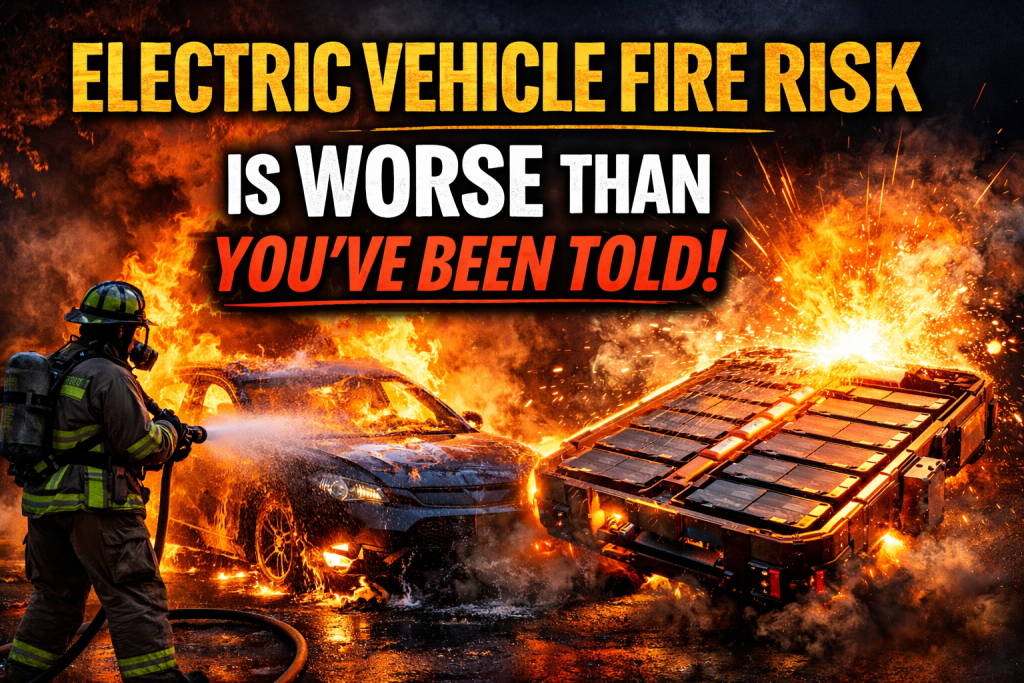
 Lets take a look at this video and its headline – Electric Vehicle Fire Risk – Is Worse Than You Have Been Told.
Now I subscribe to Barry on Youtube and he speaks a lot of common sense. I do however question this particular video where he relies on an article from The Tech Start Up CMO entitled “The truth about EV Fire Risks“
You need to read the article fully before you form any conclusions. Having read the article myself several times there are a number of flaws in the arguments.
I prefer the title Electric Vehicle Fire Risk Explained: What You’re Not Being Told
I will start by saying I have owned Electric Vehicles since 2017 and I do share the very real concerns about thermal runaway should an electric vehicle battery catch fire. In fact my third EV a Hyundai Kona was subject to a battery recall due to several cases of electric vehicle battery fires. I was advised to park it outside away from any building until its old battery was replaced with a new one under warranty by Hyundai. I therefore know the risk is real.
The article he refers to is flawed in that it is a prediction based on historical data. It uses data from China and the USA from 2020 to 2024. It uses this data to statistically predict the risk if all the cars manufactured and owned were electric and not internal combustion engines. The truth it declares” That would be a 2x – 3x risk in annual vehicles fires compared to today”
Whilst the articles correctly describes the difficulties in managing an electric vehicle fire sighting “Thermal Runaway” it takes no account of the development in electric vehicle batteries between 2020 and 2024 and it completely fails to acknowledge the new development in Sodium Nickel Chloride (often referred to as Salt Batteries.)
It also fails to consider the risks of internal combustion engine fires as those put off from buying an EV keep these cars longer with a higher risk of poor maintenance contributing to an increased risk of fire.
From 2026 CATL are producing commercially for Electric Vehicles in mass production a new “Salt” based battery called the Naxtra. You can read the CATL press release here:
Naxtra Battery Breakthrough & Dual-Power Architecture: CATL Pioneers the Multi-Power Era
Naxtra Battery eliminates combustion-supporting factors at the material level, thus achieving a transformative breakthrough from “passive defense” to “intrinsic safety .
Electric Vehicle Fire Risk Explained: What You’re Not Being Told
If you Google Salt batteries fire risk you get the following AI result
Salt batteries generally present a significantly lower fire risk compared to traditional lithium-ion batteries. Their safety profile depends on the specific chemistry used, as “salt battery” can refer to several distinct technologies:
1. Saltwater (Aqueous) Batteries
These are often considered the safest energy storage option.
Non-Flammable Electrolyte: They use a water-salt solution as an electrolyte, which is inherently non-flammable.
Zero Thermal Runaway: Because they lack flammable organic solvents, they cannot experience the “thermal runaway” chain reactions that cause lithium-ion explosions.
Abuse Tolerance: They remain stable even when punctured, crushed, or overcharged.
2. Sodium-Ion Batteries (SIBs)
While often called “salt batteries,” these are more similar to lithium-ion but use sodium salts.
Reduced Risk: Sodium-ion chemistries are more thermally stable than lithium-ion.
Performance Under Stress: In nail penetration tests, sodium-ion cells frequently show no fire or explosion, whereas many lithium-ion cells ignite.
Electrolyte Variation: Some sodium-ion batteries still use flammable organic electrolytes. While their chemistry makes them less prone to runaway, they are not strictly “fireproof” like saltwater versions. Recent breakthroughs have introduced “fire-resistant” sodium batteries using specific salt-based solid diluents to stabilize the electrolyte.
3. Sodium-Nickel Chloride (SoNick) Batteries
Often used in industrial or residential storage, these operate at high temperatures (approx. 250°C) but are considered very safe.
Inherent Safety: They are non-flammable and non-explosive.
No Fire Suppression Needed: Because they do not pose a fire risk, they often do not require the expensive fire suppression systems mandatory for lithium installations.
I am surprised the article in The Tech Start Up CMO totally ignores this major factor in its future predictions of Electric Vehicles Fires as this change to Salt Batteries will make a mockery of its prediction.
There are loads of resources on the internet containing factual tests and results if like me you are sceptical about AI results in Google. Here are a few…
Fire Risk Analysis Shows Sodium Ion Superiority
Loads more on YouTube…
Electric Vehicle Fire Risk Explained: What You’re Not Being Told.
There are many more so do please do your own research into the facts around Electric Vehicle Fires and do not be caught up in the anti EV hysteria that some areas of the media portray. Thermal battery runaway is a real risk but not as great as the hysteria in the media and that risk will greatly diminish once “salt batteries” are powering electric vehicles in the near future.
What can EV owners do to reduce fire risk?
EV owners can lower fire risk by:
1.Using manufacturer-approved charging equipment
2.Avoiding damaged or modified batteries
3.Parking in well-ventilated areas when possible
4.Keeping vehicle software updated
5.Having post-accident inspections, even after minor collisions
Thanks for reading thus far. Let me know your views in the comments below.



Leave a Reply